
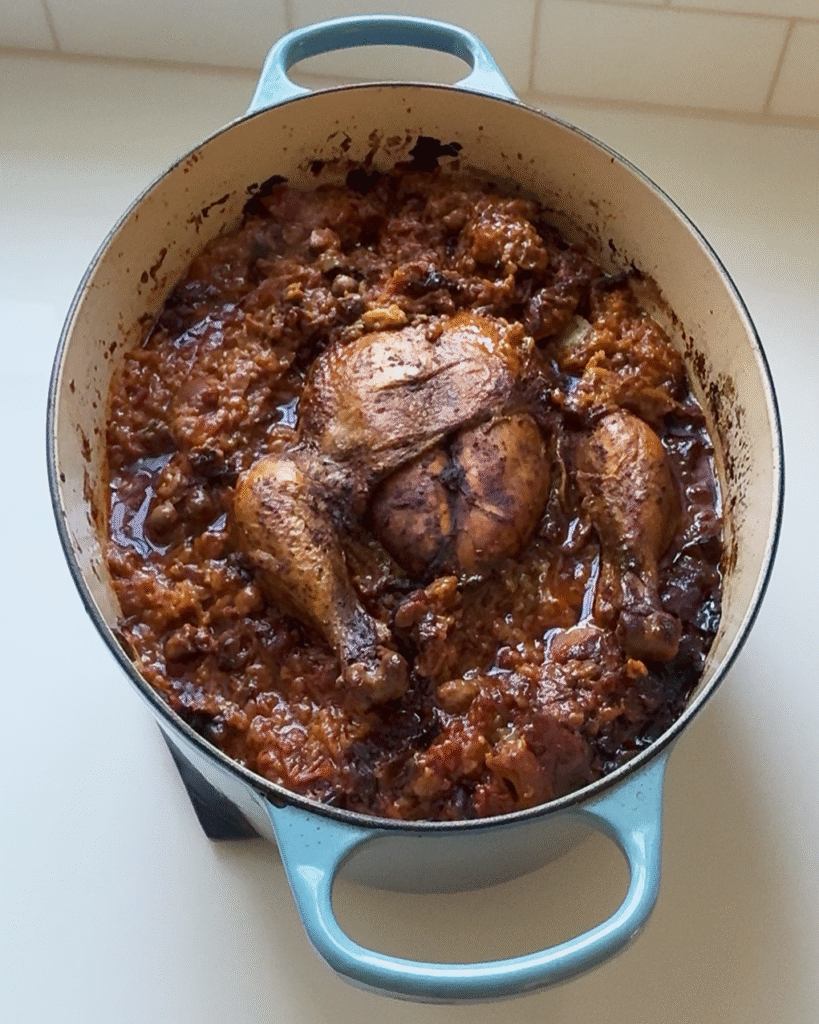
There’s something magical about waking up on Shabbat morning to the smell of t’bit.
The scent of warm spices, slow-cooked chicken and rice seem to travel through the house before anyone is fully awake. It moves through hallways and under doorways, reaching you before your eyes are fully open. The smell is comforting and familiar and almost impossible to describe (unless you grew up with it).
Every Jewish community, all around the world, has their own version of a slow cooked, overnight dish that feels like a hug in a bowl. Whether it is hamin, dafina, cholent or t’bit, they all do the same thing, they fill your belly with comfort and your heart with love.
My family history is remarkably similar on both sides. All four of my grandparents, along with their families, came from Iraq, where they had lived for generations, some in Basra and others in Baghdad. Once home to a vibrant and deeply rooted Jewish community, life in Iraq became increasingly difficult for Jews in the 1930s and 1940s. While many Iraqi Jews made Aliyah to Israel, my family left for Tehran.
My parents were both born in Iran during the Pahlavi era, at a time when the country was undergoing rapid modernization and maintained close ties with Israel. They speak fondly of life there: their international schools and Club Bahar, where the Iraqi community gathered regularly.
Eventually, both of my parents came to the United States to attend university. While they were abroad, the Iranian Revolution transformed Iran almost overnight. My grandmother once told me that she was visiting her sister in Israel when the revolution was reaching its height. Friends called to warn her not to return to Tehran, but of course she had to go back. On that return trip, she boarded what was the last flight from Tel Aviv to Tehran. Soon after, with many twists and turns, my family left Iran and settled in Los Angeles.
My father worked as an aeronautical engineer, and when I was seven my parents relocated to Seattle, leaving behind the Iraqi-Iranian Jewish community in Los Angeles.
Growing up in Seattle, Iraqi food was not familiar to most people in our Jewish community. However recognizable to me, the smell of t’bit was unknown to most of my friends. First they would be drawn in by the aroma, then surprised by the richness of the rice, the tenderness of the chicken, and the way one humble pot of food could feel both mysterious and comforting.
Like my mother, and her mother before her, and generations of mothers before them, food is the language with which I learned to show love. Living in a new city and building herself a new community, my mother did what she did best: she made t’bit. When someone had a baby, she made t’bit. When someone needed comfort, she made t’bit. When guests came over on Saturday, she made t’bit. Her t’bit was lovingly called “chicken cholent” and quickly gained fame throughout the community. Soon copycat versions of t’bit were slow cooking in homes across Seattle. All mimicking my mother’s cardamom-infused dish, each chef adding their own touch.
Now I carry that tradition forward in my own home. My kids wake up Shabbat morning to the smell of t’bit and run to the kitchen pleading to take a bite before guests arrive.
My version of t’bit uses the baharat spice blend my mother taught me. But I reduce the amount of rice and add extra chicken thighs for more flavor and chickpeas for a creamy, earthy bite. This change also increases the protein to carbohydrate ratio. My husband, who is notorious for not eating any carbs, including rice, can often be found scooping up t’bit straight from the pot, even when it’s cold.
This recipe is traditional and personal at the same time, which feels fitting. That is how tradition often works. We receive something, we live with it, and then we pass it on, imprinted with our touches. I’m excited to see where my children take it from here. If you try it out, what will you do differently? How will you make it your own?
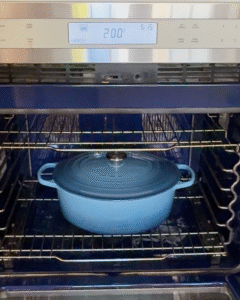
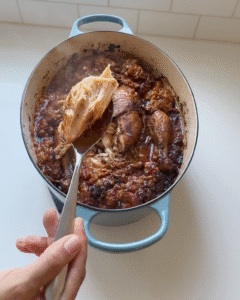
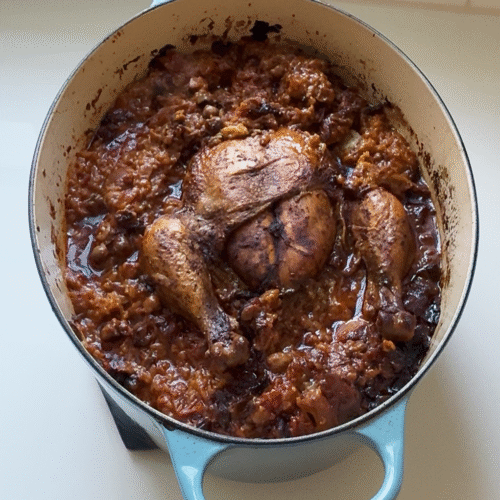
Iraqi Jewish Tabeet (Shabbat Chicken and Rice) with Chickpeas – Slow-Cooked Overnight
Ingredients
Chicken Marinade
- 3.5 lb Chicken skin on and cleaned well
- 1/2 tsp turmeric
- 1/2 tsp cardamom
- 1/2 tsp cinnamon
- 1/4 tsp black pepper freshly ground
- 1 tbsp kosher salt
- 1 tbsp avocado oil or any neutral oil
Rice and Assembly
- 1 1/2 cups basmati rice
- 2 tbsp avocado oil
- 2 large onions diced
- 2 tbsp tomato paste
- 1 tbsp cardamom fresh ground is best
- 1 tbsp cinnamon
- 2 tsp black pepper freshly ground
- 1 tsp turmeric
- 1 1/2 tsp kosher salt
- 1 tbsp chicken consume
- 1 cup tomato sauce
- 15 oz can diced tomatoes fresh tomatoes work well too
- 15oz can chickpeas rinsed and drained
- 3 lbs chicken thighs boneless, skinless and cut into 1.5 inch cubes
Instructions
- Dry your chicken with paper towels. Mix together spices and avocado oil for chicken marinade and rub all over chicken. Make sure to get under the skin and behind the legs. Careful not to tear the skin. Set in the fridge for at least an hour to absorb the flavors and allow salt to penetrate the meat. Meanwhile, prepare the rest of your ingredients.
- Wash basmati rice and set aside to drain well. In a small bowl, reserve 1 tbsp of the rice and mix in large pinches of salt, cardamom, cinnamon, a few grinds of black pepper, a spoonful of diced tomatoes and about a tablespoon of chicken thighs, finely diced. This will get stuffed into the cavity of the chicken and become the highly coveted part once cooked. For now, set it aside.
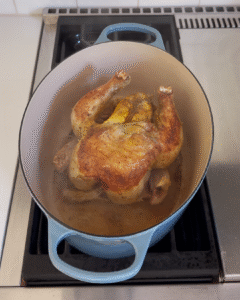
- In a large 9.5-quart dutch oven, heat 2 tbsp avocado oil over medium heat. Add whole chicken and let cook about 5 minutes per side. Remove chicken from the pot and set aside.
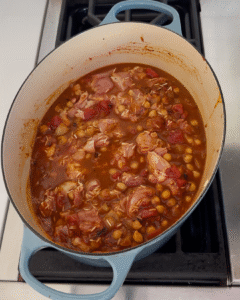
- Reduce heat to low and add onions to the pot and allow to soften, about 15 minutes. Add in tomato paste and let cook for 3 minutes, until color has darkened. Add in all of the spices and consume and use a spatula to mix well. Pour in 1 cup tomato sauce and the can of diced tomatoes. Mix in 3 lbs cubed thicken thighs and drained chickpeas. Pour in 1 cup of water.
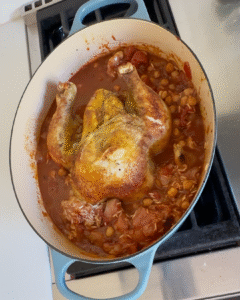
- Bring the mixture to a boil over medium heat. Stuff reserved rice into chicken cavity and nestle the chicken back into the pot with the tabeet mixture. Cover the pot and place in the oven set on 200° Shabbat mode and cook for 20 hours.
- Alternatively, this dish can be made in a slow cooker and cooked on low for 20 hours.
Thank you your recipes are amazingly delicious and the music mix is great. I want to make everything
Thank you
Ruth Sebag
adora2272@gmail.com
Thank you so much for the kind words and for making my recipes!